

TL;DR: Reviewed and compared five best MIT-licensed open-source JavaScript Gantt charts – DHTMLX Gantt Community Edition, SVAR React Gantt, Frappe Gantt, gantt-task-react, and ngx-gantt – outlining their strengths, limitations, and ideal use cases.

JavaScript Gantt chart libraries sit at the heart of many project-driven applications – from scheduling tools and construction dashboards to internal workflow systems. Because they often become deeply embedded in a product’s UI and business logic, developers have grown more cautious about what they bring into commercial codebases – especially when the component is as central and difficult to replace as a Gantt chart.
That’s why MIT and similar open-source licenses now serve as a low-friction starting point for modern teams. They impose no licensing fees or copyleft obligations, reduce the amount of licensing work you need to do, and lower the risk of vendor lock-in – which is especially important for components that stay in production for years.
Here we’ll look only at MIT, open-source JavaScript Gantt libraries that are publicly available and commercially usable. We’ll review each option on its own and then wrap up with a summary table so you can quickly see which Gantt component matches your needs best.
How We Selected Commercial‑Friendly, MIT‑Licensed Gantt Libraries
To be part of this list, each library has to meet a clear set of criteria:
- Permissive licensing – the library must be released under the MIT open-source license.
- Public availability – it needs to be published on a public GitHub repo or distributed as an npm package.
- Web-focused implementation – it has to be built for JavaScript and web environments.
- Practical documentation – it must provide documentation, demos, or examples that show how it behaves in practical scenarios.
In addition to these criteria, each project’s maintenance status was reviewed and noted separately to give readers a clear understanding of its current activity level.
Together, these selection principles keep the roundup objective, transparent, and genuinely helpful for teams choosing a free Gantt component they can rely on throughout a product’s lifecycle.
Why MIT Licensing Matters for Commercial and Internal Apps
When teams choose an open-source JavaScript Gantt chart for commercial projects, they’re not just picking a UI widget – they’re making a long-term architectural decision. At this point, the benefits of MIT-style licensing become especially clear. They impose no copyleft obligations, which means you can ship your product without worrying about releasing your own source code. They also lower vendor lock-in risks: if the library stops evolving or doesn’t fit your needs anymore, you’re free to modify it or replace it whenever it makes sense for your project.
For SaaS platforms, enterprise systems, and internal tools, this flexibility is essential. MIT-licensed components are safe to embed under permissive terms, simple to approve, and predictable to maintain – and full source access lets your team debug or extend them without relying on a vendor. In practice, MIT is free and the most commercial-friendly starting point for teams that may later upgrade to PRO or Enterprise editions. It lets you begin with an open, low-risk foundation – and scale into paid features only when your product needs them.
Best MIT-Licensed JavaScript Gantt Charts
Before diving into the individual libraries, it’s worth setting expectations. We are not going to rank MIT-licensed Gantt chart components from “best to worst” – each one solves a different problem and fits a different kind of product. Below, you’ll see the key factors teams consider when choosing an interactive Gantt component – stack, complexity, long-term needs, and control over the code.
DHTMLX Gantt Community Edition
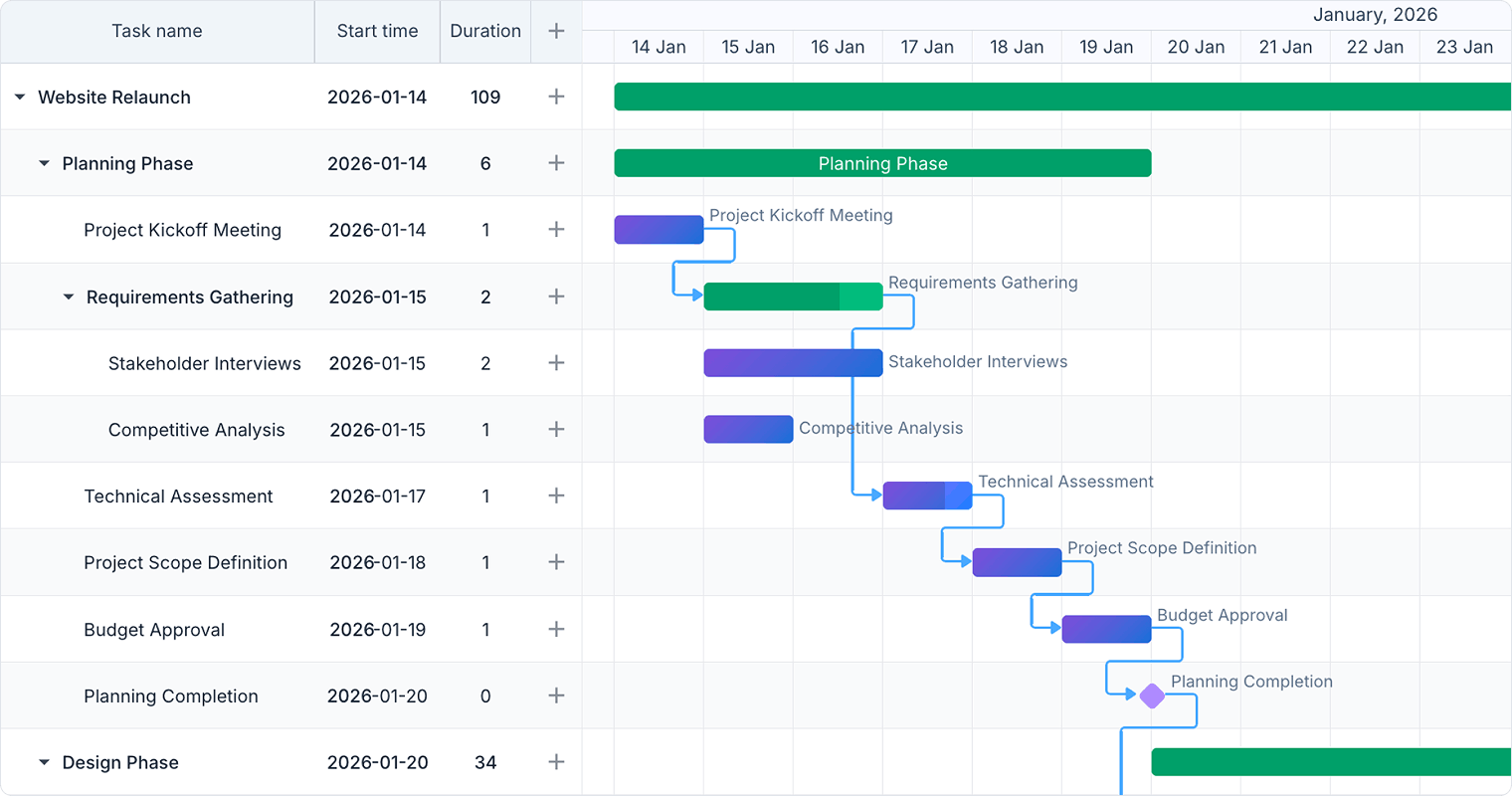
DHTMLX Gantt Community Edition is a free MIT-licensed version of a long-established Gantt chart library proven across long-running SaaS products and enterprise applications. It is one of the few JavaScript Gantt components that gives teams a commercial-friendly permissive start without sacrificing maturity. Built on a stable codebase with a wide feature surface, it offers a level of depth that most MIT Gantt charts simply don’t reach.
One of the nicest things about the DHTMLX Gantt Community Edition is the upgrade path. You can start with the MIT-licensed Community Edition for commercial, internal, or open-source products that need core Gantt functionality, then move to PRO when advanced scheduling, resource planning, or official support become necessary. For teams that want freedom now and a solid plan for later, it’s a great balance.
Key strengths
- Mature codebase with years of real-world usage
- MIT license suitable for commercial, internal, and open-source projects
- Rich feature set even in the community version (project summary tasks, milestones, multiple dependency types, drag-and-drop scheduling, smart rendering, plugins, etc.)
- Fast, efficient rendering even with 100k tasks
- Clear upgrade path to PRO for advanced features and support
- Strong documentation and demos available publicly
- Actively maintained with regular updates
Limitations
- Some advanced features (critical path calculation, auto-scheduling, resource management, etc.) are PRO-only
- Larger bundle size and more complex API compared to minimal vanilla-JS Gantt libraries
- Primarily a vanilla JS library with official React, Angular, and Vue wrappers
Best for
Teams that want a mature, production-ready MIT Gantt with the option to scale into a full enterprise solution later.
License & maintenance
MIT-licensed; actively maintained with a commercial ecosystem behind it.
Installation
Useful links
SVAR React Gantt
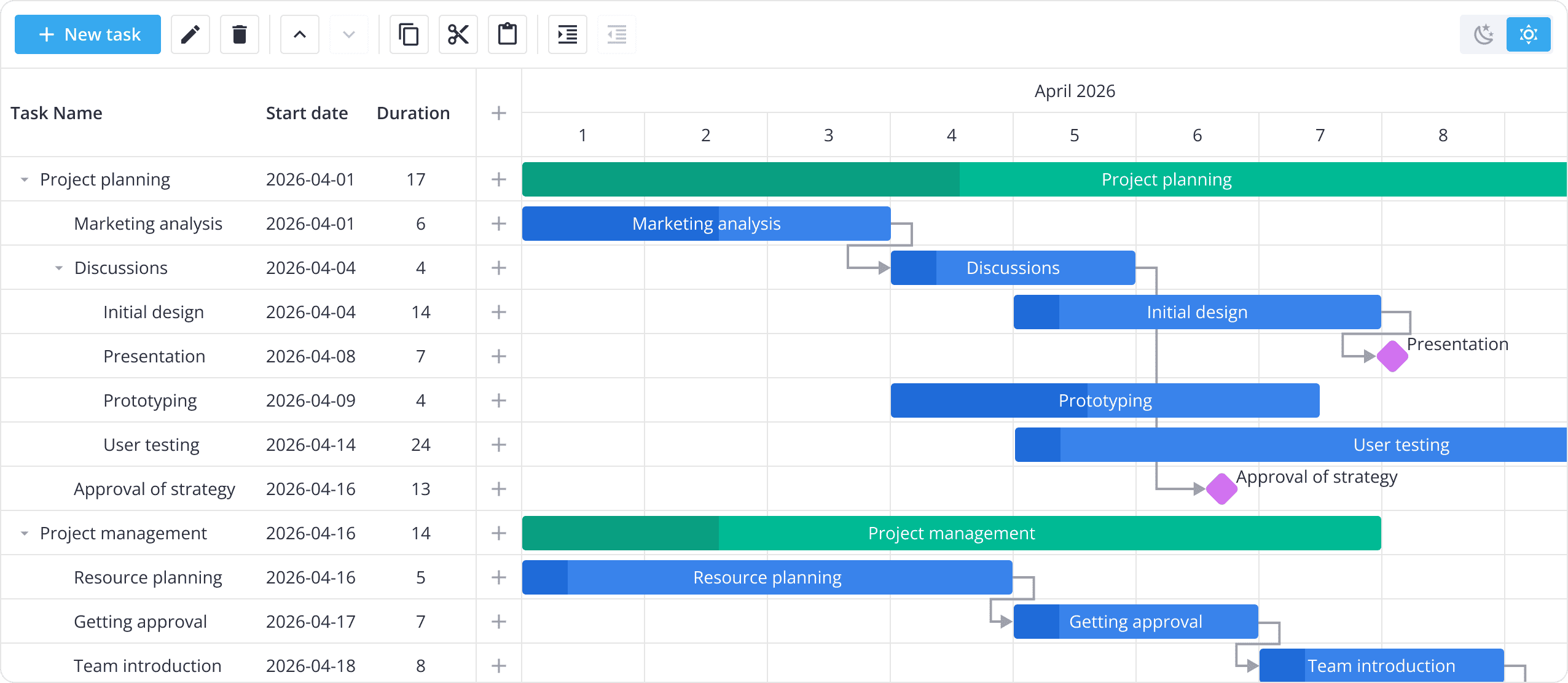
SVAR React Gantt is a native React component for creating project timelines and scheduling views, built to run directly on React’s rendering model without any wrapper layer. Its MIT-licensed core provides a permissive legal baseline, making it suitable for commercial deployments and internal enterprise systems. It delivers all the basics from editing and filtering to dependencies and drag-and-drop, and stays fast with large, complex datasets.
SVAR React Gantt library also offers a way to move from the MIT core to richer scheduling logic when needed. The open-source edition is well-suited for smaller apps and early-stage products, while the PRO edition adds auto-scheduling, slack visualization, critical path, and full resource planning capabilities without forcing structural changes.
Key strengths
- Native React component with TypeScript support
- MIT-licensed with no restrictions on commercial or internal use
- Strong performance with virtualization for large datasets
- Clear upgrade path to PRO
- Clean API, good documentation, and active maintenance
Also provides native Gantt components for Svelte and Vue
Limitations
- Advanced scheduling and resource features are PRO-only
- Smaller ecosystem compared to long-established JS Gantt engines
Best for
Teams building React-first applications that want a native component rather than a wrapper. Ideal for products that may start with a lightweight MIT core but eventually need deeper scheduling logic or resource planning.
License & maintenance
MIT-licensed core; actively maintained with a growing PRO feature set.
Installation
Useful links
Frappe Gantt
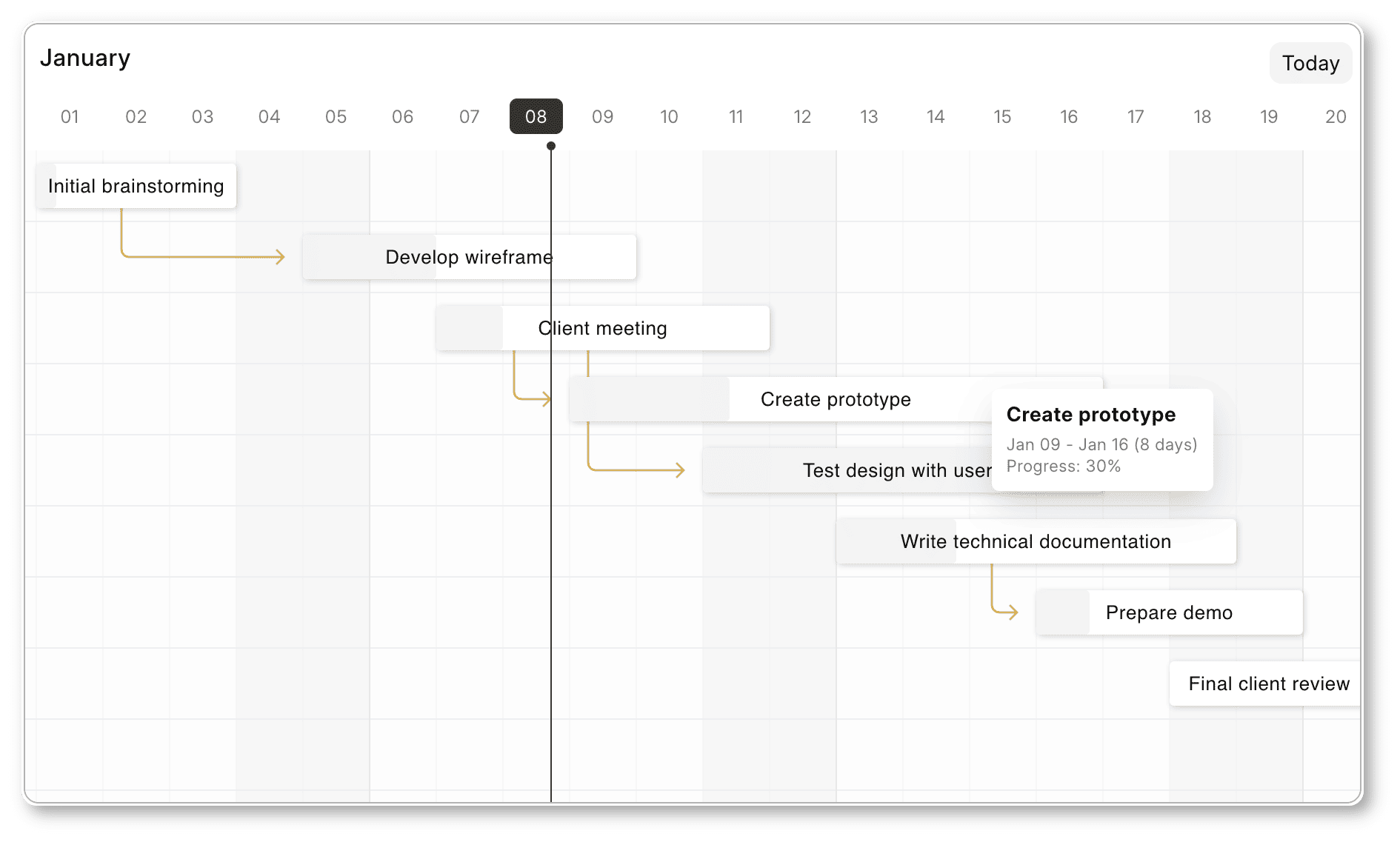
Frappe Gantt is a small, lightweight open-source JavaScript Gantt chart built for apps that just need a clear timeline view without dragging in a full project-management system. It’s an MIT-licensed library that keeps things simple: a tiny API, SVG rendering, and just enough interaction to cover basic planning tasks. You get the essentials – tasks, dates, durations, dependencies, and some straightforward drag-and-drop editing – all wrapped in a compact codebase that’s easy to read and adjust.
The library doesn’t try to compete with enterprise-level schedulers, but for lightweight timelines, product roadmaps, or simple project views, it offers a clean, approachable starting point that doesn’t pull you into a heavy framework.
Key strengths
- Lightweight and minimal – small API, small footprint
- MIT-licensed and free to use in any type of project
- Clean SVG-based UI with simple drag-and-drop editing
- Easy integration with plain JavaScript and JSON data
- Quick to customize thanks to a straightforward codebase
Limitations
- Limited feature set (no resource planning, auto-scheduling, baselines, or advanced constraints)
- Not optimized for very large datasets
- No official React/Angular/Vue wrappers – requires manual integration in frameworks
Best for
Ideal when you need something simple and MIT-friendly rather than a full enterprise scheduling engine.
License & maintenance
MIT-licensed; with community activity and occasional maintainer-merged fixes and refinements.
Installation
Useful links
gantt-task-react
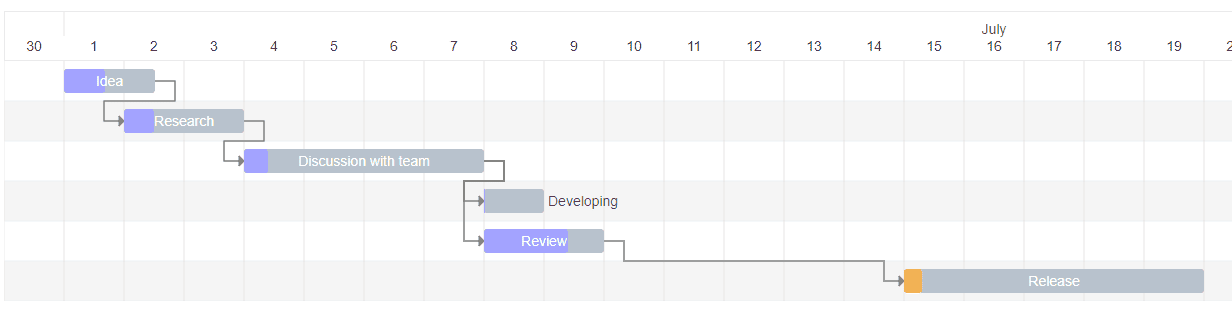
gantt-task-react is a lightweight, MIT-licensed Gantt chart component built specifically for React. It focuses on simplicity and ease of integration rather than trying to replicate the depth of a full project-management engine. The component provides the essentials – tasks, dates, dependencies, progress, and basic editing – wrapped in a clean React API that’s easy to drop into dashboards, internal tools, or early‑stage products.
Because it’s intentionally minimal, gantt-task-react is a good fit when you need a timeline or Gantt-style view without the overhead of a heavy scheduling library. It doesn’t include advanced features like auto-scheduling, resource planning, or critical path analysis, but its small footprint and permissive MIT license make it a practical choice for teams who want something simple, predictable, and React-native.
Key strengths
- Native React component
- Simple, declarative API
- Built-in progress, dependencies, and editing without extra setup
- Easy to style with React patterns (CSS modules, styled components, Tailwind, etc.)
- Lightweight footprint suitable for small to medium task lists
- MIT license for unrestricted commercial use
Limitations
- Minimal scheduling logic
- Limited scalability
- Basic editing model
- Small ecosystem
Best for
Teams that need a minimalist, React-native Gantt for timelines, roadmaps, or lightweight planning views.
License & maintenance
MIT-licensed; maintenance is minimal, but the package remains popular on npm.
Installation
Useful links
ngx-gantt
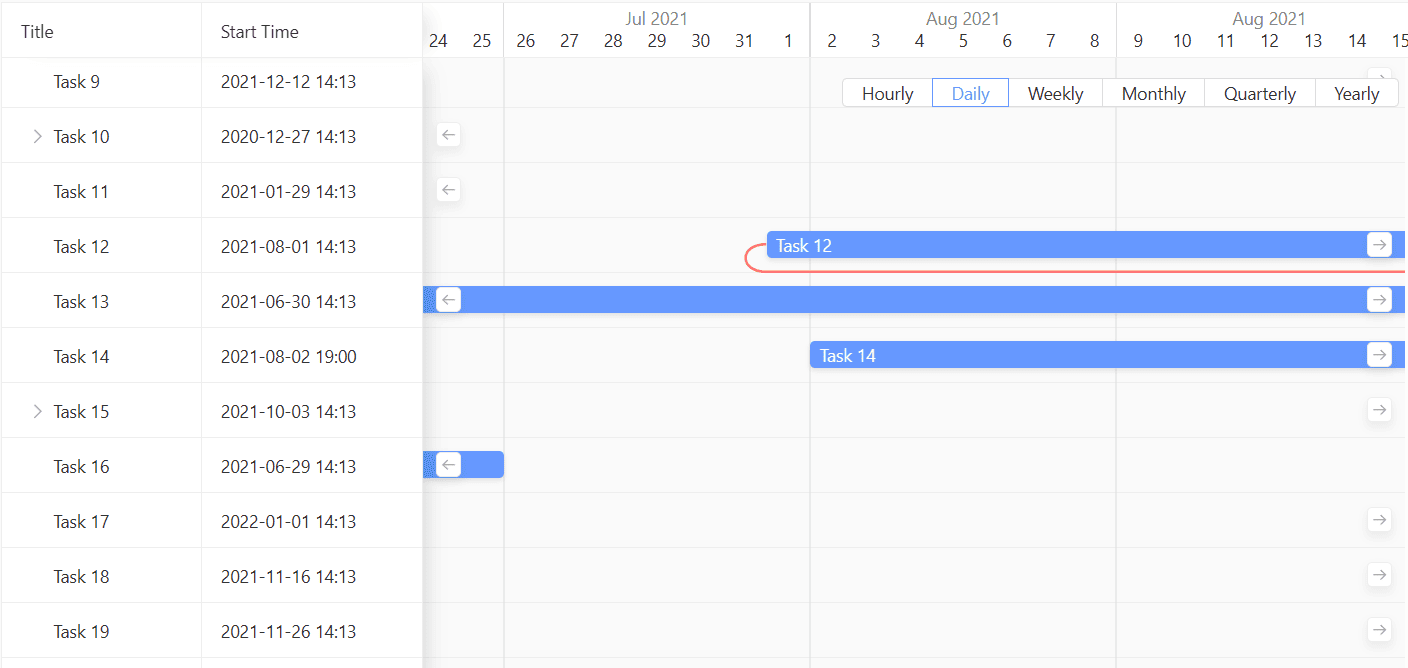
ngx-gantt is an Angular Gantt chart library, built around native patterns, using strong typing, consistent update flows, and template-driven extensibility. It doesn’t feel like an add-on, but more like another Angular module – the kind you can drop into your app immediately.
What stands out about ngx-gantt is how much it manages to offer without becoming heavy. You get a broad set of timeline features – tasks, links, baselines, progress indicators, templating options, and smooth virtual scrolling – but the component still stays approachable and doesn’t pull in a complex scheduling engine behind the scenes. For teams building Angular-first products, it strikes a comfortable balance: powerful enough for real project views, but lightweight enough to keep the codebase clean.
Key strengths
- Native Angular component with full TypeScript support
- MIT license
- Solid feature set: tasks, dependencies, baselines, progress, custom templates, virtual scrolling
- Actively maintained with clear documentation and examples
Limitations
- No advanced scheduling engine (no auto-scheduling, resource planning, or critical path)
- Not optimized for extremely large datasets compared to specialized Gantt engines
- Angular-only – no React or Vue versions
Best for
Ideal for Angular apps where the Gantt chart needs to blend seamlessly into the existing UI and component structure. Strong choice for dashboards and internal tools that benefit from Angular-style templating and customization.
License & maintenance
MIT-licensed; the repository is active, with updates and contributions continuing on GitHub.
Installation
Useful links
MIT Gantt Charts: Overview Table
Choosing between MIT-licensed Gantt libraries usually comes down to a few practical factors – the complexity you need, the framework you’re working in, and how much flexibility you want as your product grows. To help you compare those trade-offs quickly, here’s a side-by-side look at the libraries covered above.
| Product | License | Framework Support | Best For | Public Repo / npm / Docs | Commercial Use Notes |
| DHTMLX Gantt Community Edition | MIT | Vanilla JS + React, Angular, Vue wrappers | Teams needing a mature, production‑ready Gantt with room to upgrade to PRO | GitHub, npm, docs, demos | MIT core; PRO adds advanced scheduling and enterprise support |
| SVAR React Gantt | MIT | React (native) also offers native Svelte and Vue versions |
React‑first apps that may later require deeper scheduling logic or resource planning | GitHub, npm, docs, demos | MIT core; PRO adds advanced features |
| Frappe Gantt | MIT | Vanilla JS | Lightweight timelines, dashboards, and simple project views | GitHub, npm, docs | MIT; minimal features; no framework wrappers |
| gantt‑task‑react | MIT | React | Simple React timelines and roadmaps with minimal configuration | GitHub, npm, docs, demos | MIT; limited features; community‑ maintained |
| ngx‑gantt | MIT | Angular (native) | Angular apps that need a framework‑native Gantt that fits cleanly into existing UI patterns | GitHub, npm, docs, demos | MIT; no advanced scheduling engine |
Conclusion
MIT-licensed Gantt components remain a reliable choice for commercial products, especially for teams that want flexibility without worrying about lock-in or restrictive licensing. And in 2026, the open-source landscape has continued to mature – the tools are more polished, more diverse, and far more practical for real-world use.
DHTMLX Gantt Community Edition stands out as the most mature open-source Gantt chart for JavaScript apps, offering a solid feature set and a clear upgrade path for teams that may later need enterprise-grade scheduling.
SVAR React Gantt and ngx‑gantt provide framework‑native experiences for React and Angular developers, fitting naturally into their ecosystems and development patterns.
For lighter use cases, Frappe Gantt and gantt‑task‑react remain excellent minimalist choices for timelines, dashboards, and internal tools where simplicity matters more than advanced scheduling logic.
In the end, the right library simply depends on your stack and the level of scheduling complexity your product requires. With more stable, permissive options appearing each year, MIT-licensed Gantt components continue to offer a solid, future-proof foundation for long-term development.